


- Hybrid powertrain torquey and efficient
- Drive and technology good but not great
- Pricier than some rivals, not the most spacious choice
Small car buyers who prioritise saving fuel over space for luggage are likely to find the Toyota Yaris a car worth considering.
Overview
In a world in which new cars are getting bigger and bigger, Toyota stands out by taking a different approach with its Yaris supermini. At less than four metres long, the fourth-generation version of the model – introduced in 2020 and facelifted in 2024 – is small even by the standards of its segment, and is in fact 5mm shorter than its predecessor. This will doubtless strike many as refreshing – and for those concerned about practicality being affected as a result, Toyota argues that 50mm increases in width and wheelbase mean this is not an issue.
Although the Yaris’s size may go against trend, Toyota is rather more in tune with the times when it comes to electrification, with the Yaris now being hybrid-only. The model is available with a choice of two full hybrid powertrains, producing 116PS or 130PS. The latter was introduced with the 2024 update, and features a more powerful electric motor, which also delivers a 30% increase in torque. Both powertrains come with a CVT automatic gearbox.
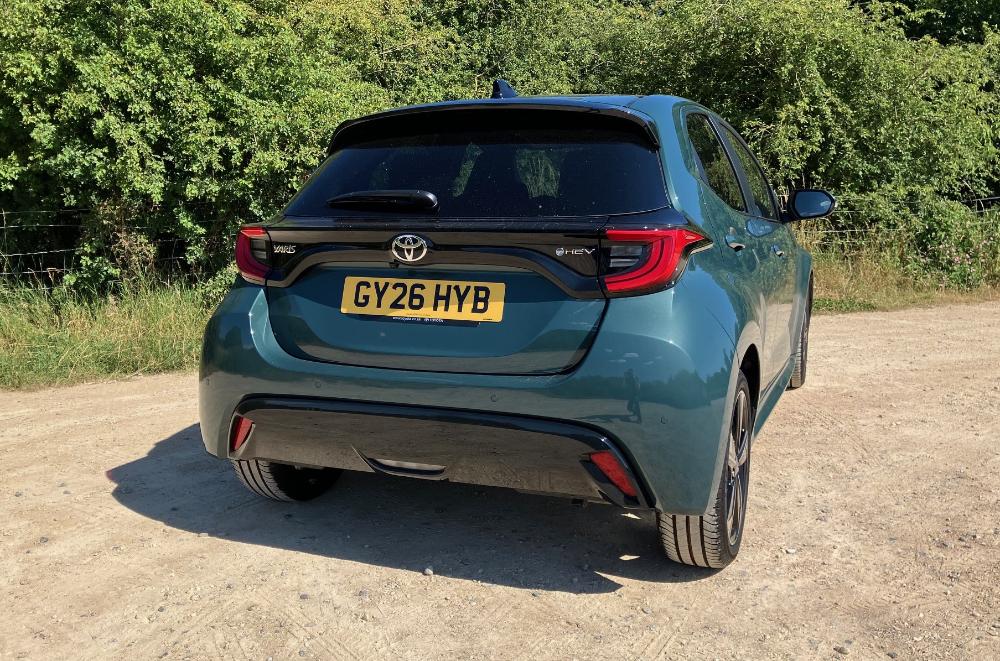
Exterior design changes were not a focus of the Yaris’s facelift, but it still looks good in the right spec. For example, we approved of our test car’s Forest Green metallic paint, and of the attractive sporty styling features it bore despite being in the luxury-focused Excel trim.
As a full hybrid supermini, obvious rivals for the Yaris include the Renault Clio, MG3 and Honda Jazz. We should also note the existence of the Mazda2 Hybrid, which is closely based on the Yaris.
Pricing and spec
The four trim levels that make up the Yaris range are divided in terms of powertrain – the lower Icon and Design trims come with the 116PS hybrid system, the Excel and performance-inspired GR Sport come with the 130PS version. This generation of Yaris has also been available as the rally-inspired GR Yaris hot hatchback, although that is not currently on sale in the UK, pending the arrival of the 2026 model year version.
A spec update earlier this year saw the regular Yaris range’s Icon and Design trims gain some extra equipment. With the Icon trim, this consisted of auto-folding door mirrors, while the Design trim got a more extensive list of new features which included new 17-inch machined alloy wheels, black fabric upholstery with contrast stitching, keyless entry and go and wireless smartphone charging.
Other equipment with Icon trim, priced from £23,860, includes 16-inch alloy wheels, automatic lights and wipers, automatic air conditioning and wireless Apple CarPlay and Android Auto connectivity, while further features of Design trim, costing from £24,910, include all-round LED lighting and rear privacy glass.
Excel trim, priced from £28,610, comes with 17-inch alloy wheels, dual-zone air-con with air filtering technology, a six-speaker audio system and fabric-synthetic leather upholstery, while equipment with GR Sport trim, costing from £30,060, includes 18-inch alloys, front GR-branded sport seats and leather steering wheel and gear lever trim with red stitching.
On purchase price, the entry point to the Yaris range is nearly £3,000 more expensive than the Clio, and around £4,500 more than the MG3 Hybrid; however, the Toyota does slightly undercut the Mazda2, and more significantly undercuts the Jazz. This picture is largely repeated when considering the Excel spec of our test car.
By default, the Yaris gets a three-year/60,000-mile warranty. However, Toyota runs a scheme whereby this can be extended by one year/10,000 miles each time the vehicle is serviced at an authorised Toyota workshop, to a highly impressive maximum of ten years/100,000 miles. Service intervals are one-year/10,000 miles.
Technology
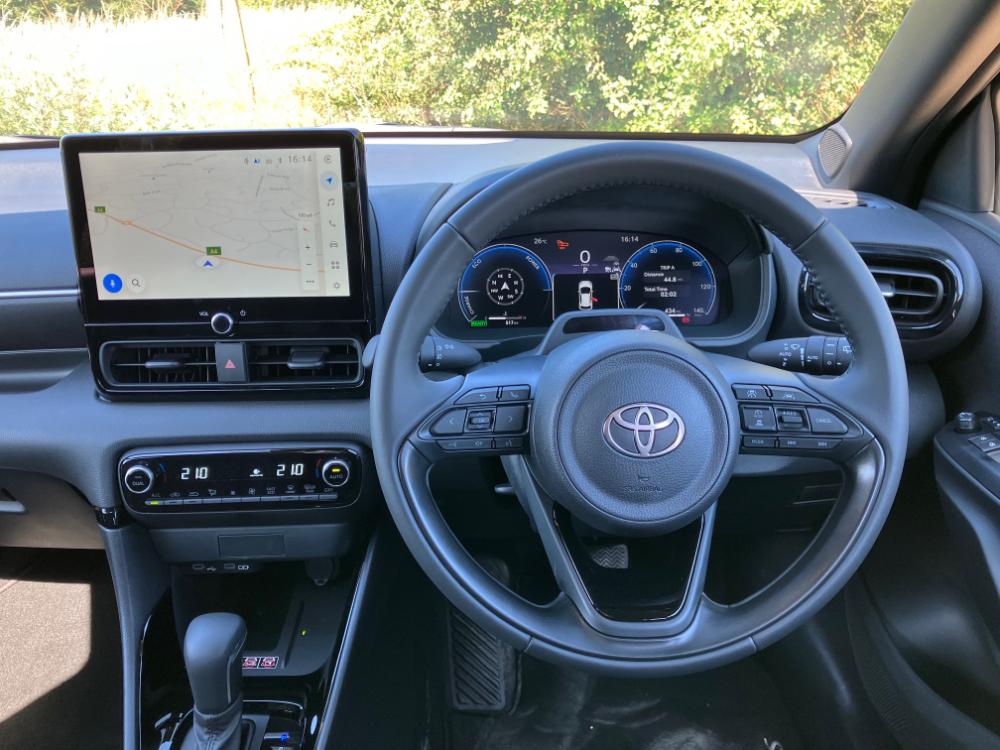
With Icon and Design trims, the Yaris comes with a nine-inch infotainment touchscreen, with Design cars also getting a seven-inch digital combimeter. Stepping up to the Excel and GR Sport trims brings a 10.5-inch infotainment screen and a 12.3-inch driver display.
We think the infotainment screen could do with being angled more towards the driver, but it’s up to standard and there are no real usability issues, besides some of the icons being on the small side and therefore sometimes tricky to hit on the move. Beneath the infotainment screen there’s the welcome provision of physical climate controls.
Functions on the driver display are operated by controls on the steering wheel which are not always the most intuitive – it took us a while for instance to work out how to zero the trip computer. The display graphics are functional but not particularly colourful, although there are plenty of customisation options to show different types of data.
Safety
All models in the Yaris range come with the Toyota Safety Sense package, with features such as autonomous emergency braking with pedestrian, cyclist and motorcyclist detection, acceleration suppression, proactive driving assist with steering assist, an emergency driving stop system, adaptive cruise control, lane trace assist and road sign assist. Further safety features with Excel trim include blind spot monitoring and safe exit assist.
A reversing camera is standard throughout the Yaris range, which is an impressive spec item – although when it is being used the guidelines on the screen don’t move with steering inputs, making the system less helpful than others.
Should drivers wish to turn off overspeed warnings (and accompanying annoying limit-change bongs) they need to enter and scroll up the driver display settings menu with the steering wheel-mounted controls.
The Yaris was tested by Euro NCAP last year and received four stars out of a possible five, with child occupant and vulnerable road user protection assessed as relative strengths.
Driving experience
With the 130PS hybrid system, as fitted with our Excel-spec test car, much day-to-day driving around town is done in EV-only mode, and even at higher speeds you will quite often find yourself cruising along with the engine off, with the transitions between the different modes handled seamlessly.
Acceleration is good for a supermini, with the increased torque of the new powertrain noticeable in situations such as joining motorways. Under heavy acceleration you do get occurrences of the droning high revs traditionally associated with CVT gearboxes – which can also crop up at lower speeds, such as when climbing a hill in town – but at least this noise isn’t too loud.
It is possible to increase the powertrain’s regenerative braking level by shifting to B mode with the gear selector, but the effects of this are fairly subtle.
You’d hope that a hybrid powertrain would provide impressive fuel economy, and on this front the Yaris delivers. On one extended motorway and A-road drive we averaged 59mpg, while on a short railway station run – the sort of journey typical for many who commute from suburbs to town centres – we achieved more than 70mpg. An official WLTP combined figure of 67.3mpg is superior to those offered by the Clio, MG3 and Jazz (and if that’s not good enough for you, 116PS versions of the Yaris have an official figure of 70.6mpg)
The Yaris changes direction quite nicely, with a bit of body roll but nothing untoward, and nicely weighted if quite uncommunicative steering, while its smallness contributes to the model being easy to manoeuvre around town. On a more negative point, the ride can jar quite harshly when running over ruts in the road.
Practicality
Despite its top-end positioning in the Yaris range, the Excel trim level doesn’t bring an abundance of exotic cabin materials – there’s still plenty of scratchy plastic around, and the overall look is pretty dark and gloomy, although it feels solidly assembled.
Despite the Yaris not being the largest car in its segment, rear legroom is reasonable, with room for passengers’ feet to go under the front seats. However, with the optional panoramic roof fitted as with our test car, headroom back there is tight for adults. There are also no rear air vents or USB charge ports.
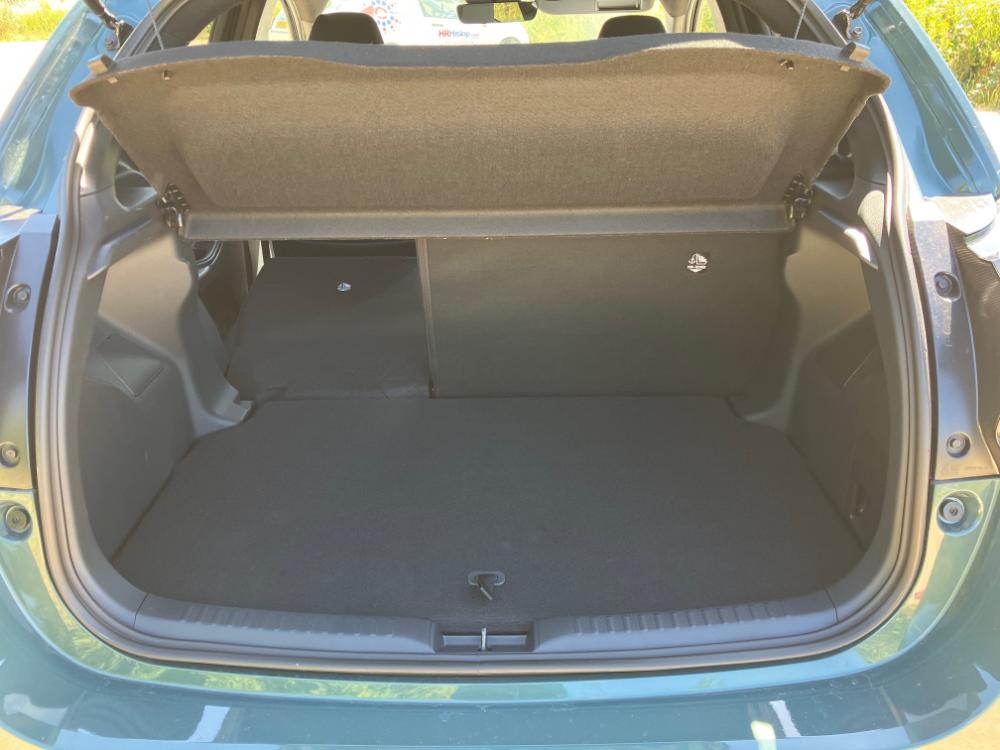
Reflecting the Yaris’s relatively compact dimensions, a 286-litre boot is on the small side for the segment. It does however benefit from a fairly low load lip, and with the adjustable boot floor in its higher position the seats fold nearly flat.