


Dealerships are increasingly being expected to balance the demands of several brands, adapt buildings designed for a previous era and ensure sales teams can answer increasingly sophisticated questions from an increasingly digitally-informed customer base.
Stellantis &You, the manufacturer-owned AM100 dealer group, today represents all nine Stellantis passenger car and van brands available in the UK and its multibrand strategy is allowing it to combine mainstream and premium franchises within individual retail locations.
Speaking to AM at the Shoosmiths automotive conference, Nigel Wells, head of network development at Stellantis &You UK, said this strategy gives dealerships the ability to balance the varying performance and positioning of different brands.
“Certain brands obviously have different resilience depending on their product life cycles,” he told AM at the recent Shoosmiths automotive conference.
Click image to watch video “With that choice, we’re able to blend the different brands. Some are more premium brands and some are more mainstream brands.
“We’re able to get that blend at the dealerships so there is a multibrand choice, without necessarily creating competition because you may have a luxury brand at one end of the spectrum and a more mainstream brand at the other.”
The strategy reflects a broader shift in automotive retail property with dealership groups increasingly expected to accommodate several franchises while making more efficient use of existing buildings and investment.
Balancing nine brands under one roof
Central to Stellantis’ approach is its Stellantis Brand House concept, which establishes a common framework for multibrand dealerships while allowing each marque to retain its individual identity.
Wells said the concept creates consistency across fundamental areas of showroom design, including flooring, ceilings and lighting.
“Stellantis has its corporate identity, which it calls Stellantis Brand House,” he said. “That tries to create a degree of commonality across the fundamentals of the showroom.
“For the mainstream brands, for instance, you will have the same floor tiles, ceiling tiles and lighting, but within that the individual brands can create their own identities.”
The model is intended to reduce unnecessary duplication while preserving the visual elements customers associate with individual brands.
However, Wells acknowledged that combining several franchises within one dealership inevitably creates competing demands for prominence and space.
“The individual brands obviously want their biggest share of the showroom,” he said. “What we try to do is deliver the minimum requirements each brand has as effectively as we can, given the space available.
“Often we’re dealing with existing showrooms, so we have to adapt and juggle between the individual brands to achieve the right representation.”
That flexibility is particularly important where Stellantis &You is working with legacy property rather than purpose-built facilities.
In those locations, the challenge is not simply to install several sets of corporate branding but to create a dealership that remains coherent and easy for customers to navigate.
Sales expertise becomes differentiator
Wells said the physical showroom is only one part of the modern retail proposition.
As customers conduct more of their research online, dealership visits are becoming less frequent but potentially more significant. Buyers often arrive with detailed knowledge of vehicles, specifications and competing products.
“I think we have to take on board the digital opportunity,” Wells said. “Customers nowadays are far more educated and they’re further down the purchase cycle than they ever historically were. We have fewer walk-ins, so our salespeople have to be more of an expert than the customer.”
This places greater pressure on dealerships operating multi-brand sites, where employees may need to understand a broad and increasingly complex product portfolio.
Wells believes product knowledge is particularly important during the transition to electric vehicles, where conflicting claims and misconceptions can make purchase decisions more difficult.
“With electrification, that is very important,” he said. “There is a lot of noise about electrification, some of it accurate and some of it inaccurate, and we have to ensure that our salespeople are experts in the field.”
Retail teams therefore need to combine detailed technical knowledge with an ability to assess how an electric vehicle will fit a customer’s individual driving patterns, charging access and ownership requirements.
Wells added that digital capability, EV expertise and the traditional ability to present the vehicle effectively must work together.
“It is digital and electrification combined with, at the end of the day, the ability to show off the product,” he said.
Building a more flexible estate
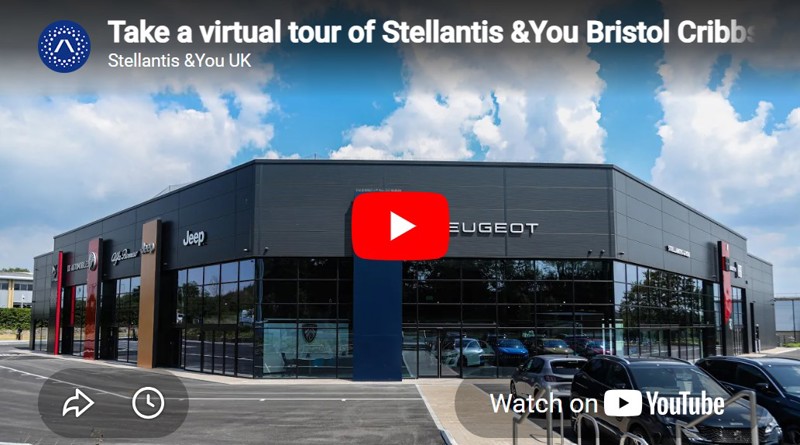
Stellantis &You’s dealership near Cribbs Causeway in Bristol provides one of the clearest examples of how the Brand House model can be applied in a purpose-built facility.
The multi-million-pound development is positioned close to the M5 on the northern approach to Bristol and accommodates several Stellantis brands.
Unlike existing properties that must be adapted around their structural limitations, the Bristol dealership was designed to incorporate Stellantis’ multi-brand ethos.
“It encompasses all of the latest corporate identity and all of the different processes as well,” Wells said.
The development also features solar panels and multiple electric vehicle charging points, reflecting both building sustainability requirements and the operational demands created by growing EV sales.
Wells said the dealership’s early trading performance had been encouraging. “We’re very pleased with it and the initial signs in terms of the performance of the dealership have been very good,” he said.
While the site demonstrates how new-build facilities can support the group’s multi-brand strategy, much of Stellantis &You’s continuing investment involves upgrading its existing estate.
Over the coming months, the group plans to continue introducing a more consistent Brand House appearance across sites around the UK with work already underway in Stockport, with further upgrades planned in Manchester, Redditch and other locations.
Wells said much of the immediate work would focus on external identity and creating a recognisable, universal appearance across the network to extract greater value and flexibility from its estate.
For more on the evolution of multibrand retail, follow AM’s latest coverage of dealership strategy, showroom investment and the changing relationship between manufacturers and retailers, click here.