


- Good all-round driving dynamics
- Much improved infotainment
- Hybrid battery has impressive range but compromises boot
The quintessential family hatchback remains an impressive contender, with a range of specs and powertrains that should offer something for everyone.
Overview
‘Legend’, ‘icon’, ‘the GOAT’ – pick your superlative of choice to apply to the Volkswagen Golf. Whichever you choose, there’s plenty of evidence to justify it, as since its introduction in 1974 more than 37 million examples of VW’s lower-medium car have been sold, including nearly 2.3 million in the UK. The model has gone through eight generations in that time, with the version currently on sale referred to as the 8.5, following updates carried out in 2024. They’ve been enough to maintain the Golf’s buyer appeal, with the model the UK’s sixth most-registered car – and the second-most popular non-SUV – so far in 2026.
The Golf is now only available in the UK as a hatchback, with the previous estate option having been dropped. At less than 4.3 metres long, thanks to its classic squared-off rear profile, the hatch is relatively small for the C-segment.
There may now be only one Golf bodystyle on offer, but VW does provide a choice of powertrain options. These include petrol and petrol mild hybrid engines – both with a choice of 115PS or 150PS outputs – and 204PS and 272PS plug-in hybrids. As if that wasn’t enough, a full hybrid option is also set to join the range later this year – although diesel powertrains were recently dropped.
Petrol Golfs come with six-speed manual transmission, the mild hybrids come with a seven-speed DSG automatic, and the plug-in hybrids come with a six-speed DSG auto.
The facelift brought a big increase in the size of the plug-in hybrid battery, from 10.6kWh to 19.7kWh, and a corresponding increase in charging speeds, with the possible rate of AC charging upped from 3.6kW to 11kW, and DC charging introduced at up to 40kW.
Over the years the Golf has effectively come to define the C-segment, taking a position roughly between mainstream models such as the Vauxhall Astra and Toyota Corolla, and premium competition such as the BMW 1 Series and Mercedes-Benz A-Class. Other alternatives are the Golf’s closely related VW Group cousins the Skoda Octavia, Seat Leon and Audi A3.
Pricing and spec
Some manufacturers claim that a slimmed down range offering, with perhaps two or three trim options, is preferred by customers. This is clearly not a view shared by VW, since the Golf is sold in the UK with six core trim levels – Life, Match, Style, R-Line, Black Edition and GTE – in addition to several GTI and R performance variants (perhaps confusingly, VW considers the plug-in hybrid GTE to be a core trim despite sharing many elements with the GTI).
Standard features with entry-level Life trim include 16-inch alloy wheels, LED headlights and taillights, automatic climate control and wireless Apple CarPlay and Android Auto connectivity, while features of Match trim (the spec we tested) include 17-inch alloys, tinted rear glass, keyless entry and go and a leather steering wheel.
Features of Style trim include chrome exterior strips, an illuminated front VW logo, ‘sports comfort’ seats with ArtVelours covers, 30-colour interior ambient lighting and three-zone climate control, while the sports-inspired R-Line trim features various gloss black exterior elements along with sports suspension, a heated steering wheel and driving profile selection.
Equipment with Black Edition spec include 18-inch alloy wheels, matrix LED headlights and dynamic rear indicator lights, while the GTE comes with various features taken from the GTI.
Prices for core Golfs start at £28,910 for a 115PS petrol Life, and rise to £40,145 for a GTE (the most expensive Golf currently available is the R Black Edition performance variant at £48,250).
A basic price comparison between the Golf and its rivals offers few surprises, with the entry-point to the range more expensive than the Astra, Leon and Octavia (although by less than you might expect in the case of the Skoda), and cheaper than the 1 Series, A-Class and A3. The Golf does also undercut the Corolla, with that model being hybrid-only. As for the Match 204PS plug-in hybrid (badged eHybrid) spec we tested, priced at £36,485, predictably this is more expensive than the cheapest Astra PHEV – but more surprisingly it undercuts the plug-in hybrid Leon, with Seat only applying the powertrain to higher-spec trims.
The Golf comes with VW’s standard three-year/60,000-mile warranty. The batteries in plug-in hybrid versions are covered by an eight-year/100,000-mile warranty.
Service intervals are 12 months/10,000 miles as standard, although VW also offers a flexible servicing regime aimed at higher-mileage drivers, with vehicle sensors monitoring the condition of parameters such as oil pressure and brake pad wear to establish when a service is needed.
Technology
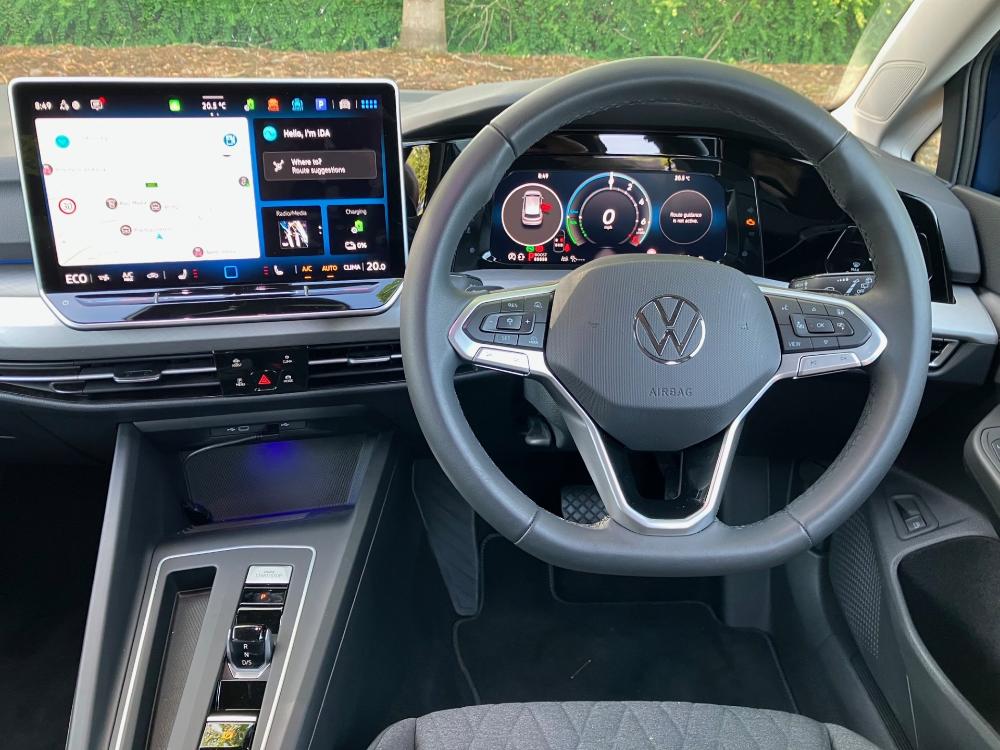
A major focus of the Golf’s 2024 update was the introduction of a new-generation infotainment system, running on a 12.9-inch touchscreen. The screen itself is easy to read, with extremely sharp graphics, and very responsive to touches. VW’s main goal with the infotainment update was to make the system easier to use, and to this end there are loads of shortcut icons, both on toolbars at the top and bottom of the screen itself and via touch buttons underneath, designed to make it quicker to access functions. There are so many shortcuts, in fact, that it can take a little bit of time to get used to where they all are – but we don’t doubt that they will greatly aid usability once drivers are acclimatised.
Below the screen are slide controls which adjust the temperature and audio volume. These were much criticised when VW first introduced them but have been improved since – though you do have to take care not to brush them by mistake when operating the touchscreen to avoid unwanted changes.
In front of the driver is a 10.2-inch Digital Cockpit Pro screen, featuring three customisable ‘dial’ areas on which a wide range of information can be selected for display, meaning drivers should have no trouble setting it up to their liking. This configuration is done via buttons on the multi-function steering wheel – another new feature with the 2024 facelift, replacing the previous wheel-mounted touch controls.
The Golf comes with ‘Ida’, a voice assistant incorporating ChatGPT, which VW says can maintain context over long conversations and answer general knowledge questions. Its main focus however is on more common in-car tasks like adjusting the temperature or radio station – and it didn’t seem to us to be much better at these than traditional voice control systems.
Safety
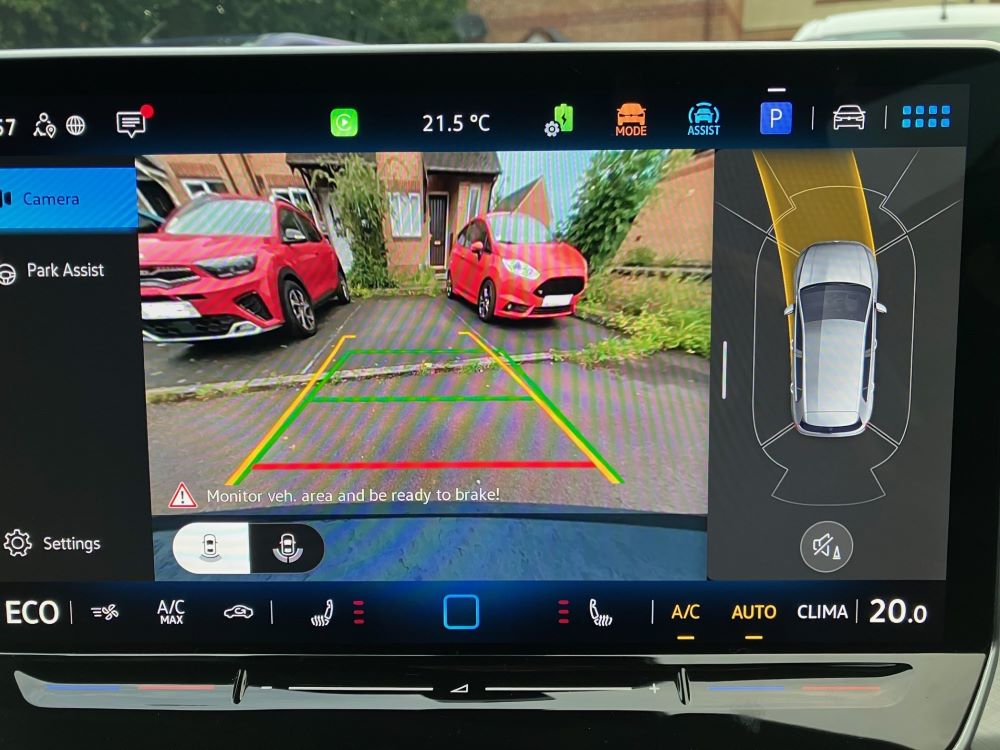
The level of driver assistance available scales up through the lower end of the Golf range line-up. That’s not to say that entry-level Life cars are sparsely equipped, featuring as they do driver attention and drowsiness monitoring, dynamic road sign display, front and rear parking sensors, adaptive cruise control, automatic emergency braking with pedestrian and cyclist detection, lane assist, rear traffic alert, oncoming vehicle braking when turning functionality, a lane change system and an exit warning system. Match trim adds high beam assist, a reversing camera and Park Assist with park distance control, and Style trim adds semi-automated driving assistance.
The reversing camera system offers a strangely narrowed view which makes it look like ordinary parking spaces are tighter than they really are. This combines with overly alarmist proximity sensors to make reverse parking a more stressful process than it ought to be.
Overspeed warnings can be switched off with two presses of the touchscreen, as can other assist functions such as lane assist, should drivers wish.
The Golf was tested by Euro NCAP last year and received a full five-star safety rating, with particularly high marks for child occupant protection – obviously a major plus point with a family car.
Driving experience
Plug-in hybrid Golfs in EV-only mode – which the system defaults to on start-up, though this can be over-ridden – are capable of reasonable acceleration up to and including motorway speeds. With the petrol engine also joining in the Golf’s acceleration enters warm hatch territory – 0-62mph is officially possible in 7.4 seconds. The powertrain’s operation is always smooth and refined.
It is possible to choose between low, high (though not full one-pedal) and ‘automatic’ levels of regenerative braking. The latter can automatically increase the level of regen when the car is coasting towards road features like a reduced speed limit or junction to help it reach an appropriate speed – a clever function which is well executed.
The eHybrid has an official WLTP combined fuel economy rating of 252.9mpg – of course, real-world performance will depend on how often the battery is charged. Over the course of our 557-mile test, during which the EV battery was fully charged once having been delivered with a 79% charge, we achieved 73.2mpg. Officially, a highly impressive EV-only range of up to 88 miles is available – the numbers we saw during a dedicated section of EV-only running during our test suggest that this figure is not unreasonable.
As a drive the Golf is simply a very nicely sorted car overall. It handles very well, with a great sense of pointiness at the front end when turning into corners and lots of grip – helped by an electronic differential lock being fitted as standard – and the ride generally is nicely compliant, though it does thud a bit into the odd pothole around town, which may be partly attributable to the extra weight of the plug-in hybrid powertrain (around 300kg more than a petrol Golf). The steering could maybe do with being a touch heavier for B-road work, but its weighting makes sense the rest of the time.
Practicality
With Match spec the Golf’s interior has quite a grey aesthetic, save for some brushed metal trim elements. You do get a good amount of fabric, leather and other soft-touch trim at key locations, and – VW review cliché alert – everything feels solidly assembled, if perhaps not true premium quality. We were a little surprised that with our Match test car all seat adjustment was manual, while heated seats were only fitted as optional extras.
Despite the Golf’s relatively small size for the segment, rear leg and headroom are decent. With plug-in hybrid Match Golfs coming with three-zone climate control as standard, rear passengers also benefit from their own temperature control panel – an impressive spec item to have at this point in the range. There are also two rear USB-C ports.
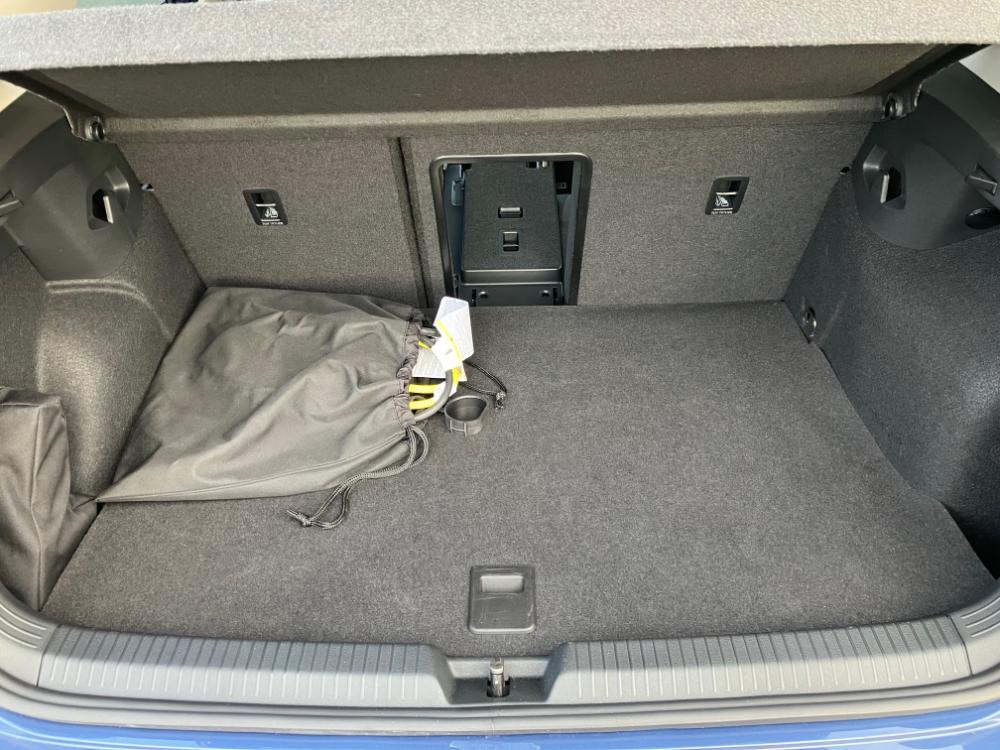
Most Golfs have a boot capacity of 381 litres – already a little below par for the segment, and this is reduced to 273 litres for the plug-in hybrid version, which additionally has no separate compartment for storing its charging cables. The boot does benefit from a low if not quite flat lip, and there’s also a ski hatch, allowing long items to be loaded through into the cabin without needing to fold the rear seats.