



Can the industry keep pace with its own ambition?
By Craig Gottlieb and Jeff Wheless, Accenture
Commercial aerospace enters 2027 with double-digit growth and a focus on production, supply-chain resilience, and execution. Accenture’s latest Commercial Aerospace Insights research forecasts industry revenue to grow 11.5% in the year ahead, with combined deliveries from the largest aircraft manufacturers rising 12%. The executive survey shows that 85% expect revenue to continue growing over the next two years, reflecting sustained industry optimism.
That optimism exists despite an increasingly variable environment. Whether it is competition for parts, financial capital, and material from the burgeoning AI buildout or the surge in defense spending and production, commercial aerospace and defense companies must overcome a host of evolving constraints to meet those delivery obligations. To do so while maintaining momentum to close the gap between demand and delivery, commercial aerospace companies are focused on strengthening a portfolio of physical and digital capabilities across manufacturing, supply-chain, data, and AI.
Demand tests supply resilience
With aircraft backlogs approaching 60% of the active fleet, well above the historical norm of 30–40%, the focus of commercial aerospace executives is squarely on delivery. OEMs and suppliers are expanding capacity, but the cruel game of supply chain whack-a-mole across ATA chapters from engines to interiors and beyond continues to undermine production stability and delivery predictability. These ongoing challenges are reflected in our survey. Ongoing teething problems across the supply chain led only 65% of executives to believe their suppliers could meet or exceed expectations over the next six months, the lowest level since COVID-19.
This reflects a near-term execution challenge of a growing industry approaching record production rates, and a need to scale amidst continued fragility of a recovering supply chain. The same supply chain, that now must handle additional demand from adjacent industries. Competition for critical materials is intensifying as AI and data-center growth drives semiconductor demand and puts pressure on affordable electricity—increasing electronics and aluminum supply risks.
For airlines, higher fuel costs and geopolitical disruption are squeezing profitability even as passenger traffic grows. To preserve capacity despite new aircraft delivery delays and elevated lease prices, airlines are extending aircraft lives and increasing utilization—and aging fleets need more maintenance. This continues benefiting the aftermarket sector, with 76% of executives expecting maintenance, repair and overhaul (MRO) spending to increase over the next two years. MRO providers are looking to capture this sustained demand while preparing for a gradual normalization in the maintenance mix, as annual retirement averages are forecast to nearly double between 2027 and 2030.
Capabilities will define the next phase of growth
To meet the demand, companies are advancing physical and digital investment together as a portfolio of capabilities. They focus on increasing throughput from existing capacity by improving manufacturing and industrial operations and supplier management, alongside investments in AI, generative AI, data, and digital foundations. In combination, physical investments help boost output, while digital capabilities help improve visibility, decision-making, and efficiency. A clear focus on fulfilling existing orders without compromising quality sits at the center of the 2027 growth agenda.
MRO providers are also investing in productivity, workforce capabilities, and digital tools to get more from existing resources. Pratt & Whitney’s AI-assisted borescope inspection has cut inspection time by more than 30% and report generation from hours to minutes. High demand is also sustaining M&A activity, as aftermarket companies seek faster access to constrained capacity and specialized repair capabilities.
No single route to capability expansion
It’s all well and good to know you need to build capabilities, but how do they get built? Our research results indicate that companies favor internal development across most capability domains but take different approaches where external expertise offers an advantage. They prioritize building in-house across engineering, manufacturing, MRO, and digital foundations where ownership, operating knowledge, and control create sustained advantages. Airbus’s second A320 Family final assembly line in Toulouse illustrates this approach, adding capacity and flexibility for the production ramp-up while integrating digital controls, automated logistics, and robotics to optimize workflows.
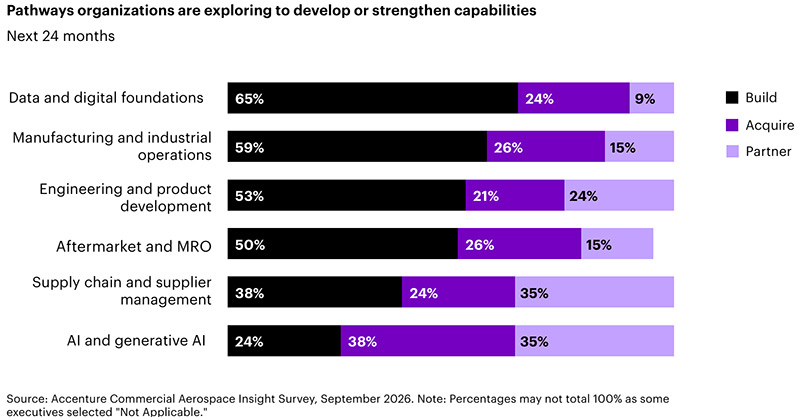
AI is the exception, with 38% of executives prioritizing acquisitions, 35% partnerships, and only 24% internal development. Talent shortages, the leading barrier to developing AI capabilities, help explain this preference. As technologies and skills continue to evolve rapidly, companies are more willing to access expertise externally. Honeywell Aerospace’s collaboration with Shield AI is one example, combining its Hivemind autonomy software with Honeywell’s avionics for potential commercial aviation applications.
Sustaining growth ahead
Delivery is the priority for commercial aerospace. Companies that continually fine-tune their capability mix will be best placed to keep pace: acquiring proven capabilities that complement existing strengths, building in-house where control matters most, and partnering with the wider ecosystem where external expertise moves faster. This flexibility will be key to sustaining growth in 2027 and beyond.
About the Authors:

Craig Gottlieb is a managing director in Accenture’s Americas aerospace and defense practice. With over 27 years of experience, he has worked with major OEMs, suppliers, and new entrants across engineering, supply chain, manufacturing, aftermarket services, talent, and corporate strategy. He’s a frequent contributor to industry publications and sits on the AIA Engineering and Technology Leadership Council. He is based in Hartford, Connecticut.

Jeff Wheless leads Accenture’s global research for the industrial sector. His team provides intelligence, thought leadership and market insights for aerospace and defense, automotive, industrial, transport and logistics, and Industry X markets. He’s based in Phoenix, Arizona.