


- Good balance between handling and ride quality
- Well designed and equipped interior
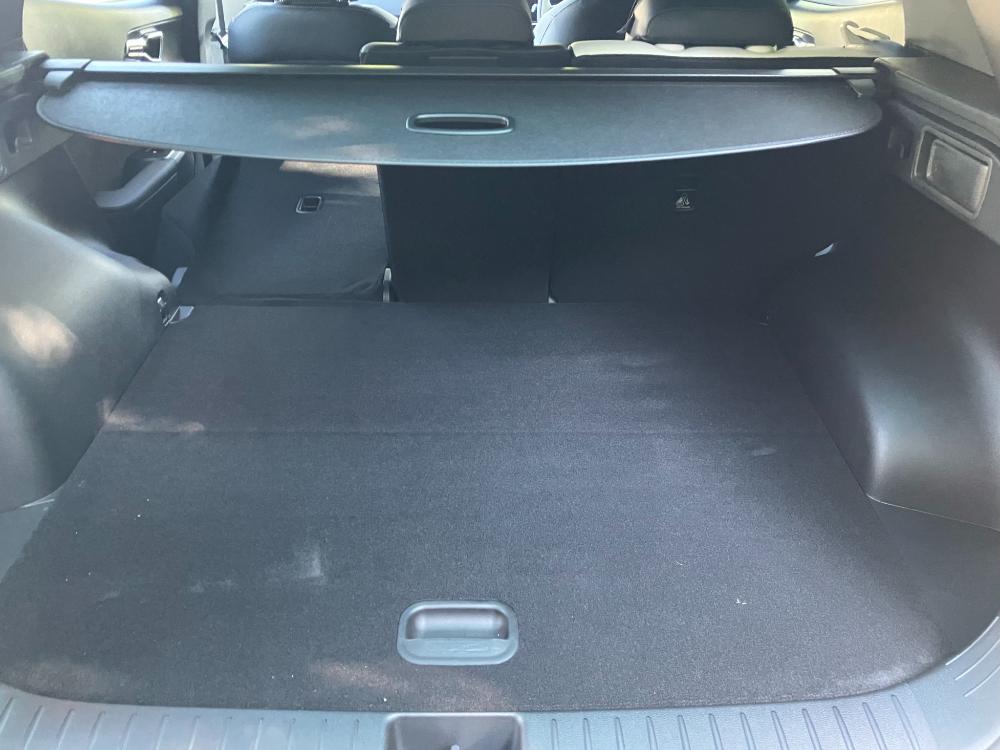
- Large and practical boot
The Kia Sportage covers all the bases in the medium SUV segment, offering an assured drive, impressive design and day-to-day practicality.
Overview
Kia is a manufacturer that has made gigantic strides in the UK over the past few decades, going from a largely overlooked if not derided budget badge to a popular and well-respected mainstream player. The Sportage medium SUV has been a cornerstone for the brand throughout that journey, with Kia recently announcing that it has sold half a million examples of the model in this country across the five generations seen since its market debut in 1995. The latest generation, launched in 2022 and updated last year, has proved to be the most popular Sportage yet – it was the UK’s second most-registered car in 2025, and has retained that ranking during the first half of 2026. We would also note that the hybrid version of the Sportage, which we drove for this review, was the UK’s most-registered hybrid last year.
Alongside the hybrid, which features a 1.6-litre petrol engine and an electric motor for a total output of 239PS and 265Nm of torque, powertrain options with the Sportage also include pure petrol, with a 1.6-litre engine outputting 150PS and 250Nm of torque. The hybrid powertrain is available with front-wheel drive (as tested) or all-wheel drive, and comes with six-speed automatic transmission. The petrol engine comes with front-wheel drive, and either six-speed manual or seven-speed DCT automatic transmission.
A plug-in hybrid powertrain option for the facelifted Sportage is due to arrive at a later date – Kia says the pre-facelift Sportage PHEV remains available to buy from stock.
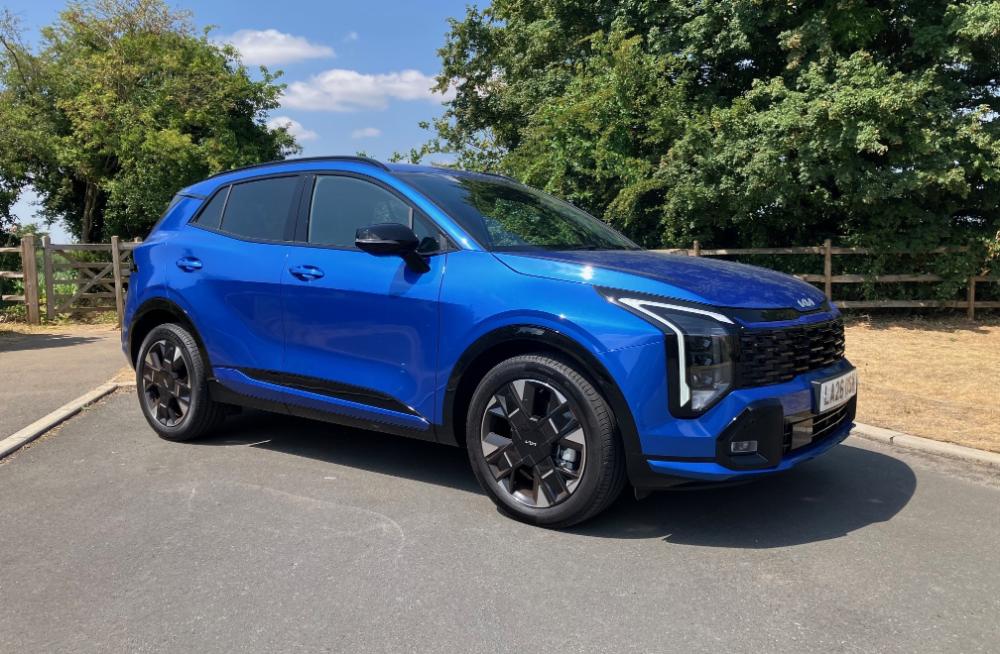
Design changes made with the facelift include the addition of ‘star map’ daytime running lights and tail lights, a new larger front grille and new front and rear bumper designs.
The Sportage’s sales success has been achieved despite facing a pack of formidable rivals in the medium SUV segment. These include its group cousin, the Hyundai Tucson, and the car that kickstarted the new car market’s SUV revolution, the Nissan Qashqai, while recent months have also seen the well-publicised emergence of the Jaecoo 7 as a serious sales threat.
Pricing and spec
Following last year’s facelift, the core Sportage range consists of Pure, GT-Line and GT-Line S trim levels. Standard features with the Pure grade, priced from £30,885, include 17-inch alloy wheels, all-round LED lights, electrically adjustable heated and folding door mirrors, automatic lights and wipers and automatic air conditioning.
Further features of GT-Line trim, the best seller in the Sportage line-up, priced from £33,385, include 18-inch or 19-inch alloys (depending on powertrain), LED front fog lights, GT-Line exterior styling, gloss black exterior detailing, rear privacy glass, heated front seats and a heated steering wheel.
Extra features with the range-topping GT-Line S trim, priced from £40,285, include dual LED headlights with adaptive high beam, a panoramic sunroof, ventilated front seats, heated outer rear seats, a smart power tailgate, electric driver and front passenger seat adjustment with driver’s seat memory function, a head-up display and a wireless phone charger.
In addition to the main trims, Kia also recently announced a new special edition Storm version, described as sitting between the GT-Line and GT-Line S trims with some Pure styling elements. Priced from £34,395, notable features include Storm-only black artificial leather upholstery, heated and ventilated front seats, a smart power tailgate and a wireless smartphone charger.
The Sportage is closely related to the Tucson, and correspondingly the models’ prices are very evenly matched, with the Sportage £50 cheaper as an entry-level car and £60 cheaper at an equivalent spec to our test car. Entry-level prices for the Sportage and Qashqai are also close, but the Sportage hybrid GT-Line we tested comes in cheaper than an equivalent Qashqai e-Power. Unsurprisingly, however, the Jaecoo 7 – with which hybrid is unusually the cheapest powertrain option – comes in several thousand pounds cheaper in an equivalent spec to our test car, although interestingly the gap in range starting price is much closer at just over £1,500.
The Sportage benefits from Kia’s familiar, impressive seven-year/100,000-mile warranty – a potential advantage over the Tucson, which only gets a five-year warranty, although Hyundai doesn’t set a mileage limit. Service intervals for the Sportage are 12 months/10,000 miles.
Related reading: New car review: Nissan Qashqai benefits from clever electrified tech
Technology
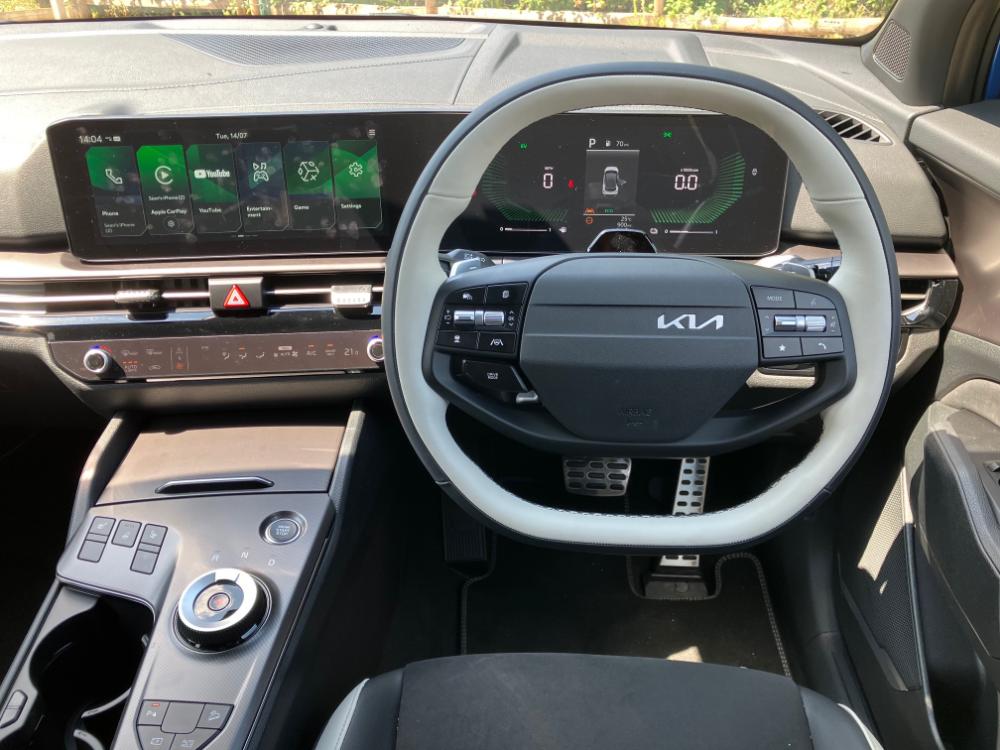
All Sportages come with a 12.3-inch infotainment touchscreen with sat-nav and wireless Apple CarPlay and Android Auto connectivity. The infotainment screen is nicely responsive, though we found it a slight stretch to reach icons on the left-hand side. The integrated sat-nav also works well, bailing us out in a situation during our test when we didn’t have phone reception. Climate controls – a combination of physical knobs and touch buttons – are usefully placed on a separate panel below the main screen.
Kia says Pure and GT-Line cars only come with a 4.2-inch driver display, but most drivers likely won’t notice much difference from the full 12.3-inch driver display fitted with GT-Line S and Storm spec, since the smaller display is flanked by fully digital dials.
Safety
Standard driver assistance systems throughout the Sportage range include front and rear parking sensors, a reversing camera, lane keep assist, lane follow assist, cruise control (smart cruise control on cars with automatic transmission), driver attention warning, dynamic braking control, a multi-collision braking system and forward collision avoidance assistance. GT-Line S spec adds a 360-degree camera system, safe exit warning, blind spot collision avoidance assist, upgraded forward collision avoidance and cruise control systems, and remote parking (the latter with hybrids only).
Overspeed warnings can be muted, and lane assist switched off, should drivers wish, by holding down buttons on the steering wheel for a few seconds. However, should drivers also want to turn off audible notifications of speed limit changes – which we find particularly grating – they will need to go into the main settings menu on the infotainment screen.
The pre-facelift Sportage was tested by safety organisation Euro NCAP in 2022, when it received a full five-star rating.
Driving experience
With 239PS on offer, acceleration with the hybrid Sportage is impressive – officially 0-62mph can be performed in less than eight seconds. A fair bit of everyday driving is handled by the electric motor alone, and the petrol engine isn’t too noisy when it is required.
During our time with the Sportage, which mainly consisted of A-road and motorway driving, we averaged 46.2mpg – down on the 54.5mpg we achieved a few months ago with the Nissan Qashqai e-Power, though this is not unexpected given their official WLTP combined ratings are 50.4mpg and 62.8mpg respectively. On official figures the Sportage is also very slightly less economical than the hybrid Jaecoo 7.
As a drive the Sportage offers a really good balance between ride comfort and dynamic ability. Ruts and undulations in the road are dealt with well, with a good level of cushioning from the suspension without any floatiness, while there’s plenty of grip, stability and responsiveness in corners, allowing drivers to tackle twisty roads with confidence – what little body roll there is comes predictably and manageably. The steering is on par for a family SUV – there is the option to make it a bit heavier by selecting the Sport driving mode but this doesn’t make a significant difference to the driving experience.
Practicality
On entering the Sportage – once past the unusual gameshow-style jingle which plays when you enter or exit – we picked up something of a classic car vibe from the white flashes of trim on the seats and steering wheel rim (not to mention the squared-off, Austin Allegro-esque shape of the latter). The wheel was a new item with the facelift and has similarities with those found in Kia’s EVs, including the inclusion of a drive mode select button, previously on the centre console, for easier access. Instead of a traditional lever, gear selection is handled by a rotary control.
Driver’s seat adjustment is mostly manual with Pure and GT-Line trims, but you do get electrically adjustable lumbar support throughout the range. The seats themselves we found to be comfortable on long drives.
With GT-Line trim, interior material quality is generally good. There’s plenty of artificial leather and other soft-touch materials, and scratchy plastics are mainly limited to lower down in the cabin. There’s a reassuringly chunky feel to controls such as the indicator stalks.
Rear legroom is pretty good, and headroom plentiful. Rear seat passengers also benefit from three-zone climate control with dedicated ventilation controls, USB-C ports neatly integrated into the backs of the front seats (from GT-Line trim up), and useful storage hooks, also provided on the front seatbacks.
The Sportage has one of the largest boots in the medium SUV segment, with a capacity of 591 litres for petrol versions, and 587 litres for hybrids – nearly 100 litres bigger than the boots found with the Qashqai and Jaecoo 7. The Sportage’s rear seats feature a practical 40:20:40 split-folding arrangement and can be folded via levers by the tailgate. An adjustable boot floor is also provided – with this in its highest position the Sportage offers a flat load lip, and seats which fold nearly flat. There’s also a roll-up luggage cover/parcel shelf.