


- Usefully upgraded infotainment
- Firm ride not compensated for with driving dynamics
- Rivals offer better value and more practicality
The Nissan Juke is an established sales hit in the small SUV segment but doesn’t really stand out in any way against current rivals.
Overview
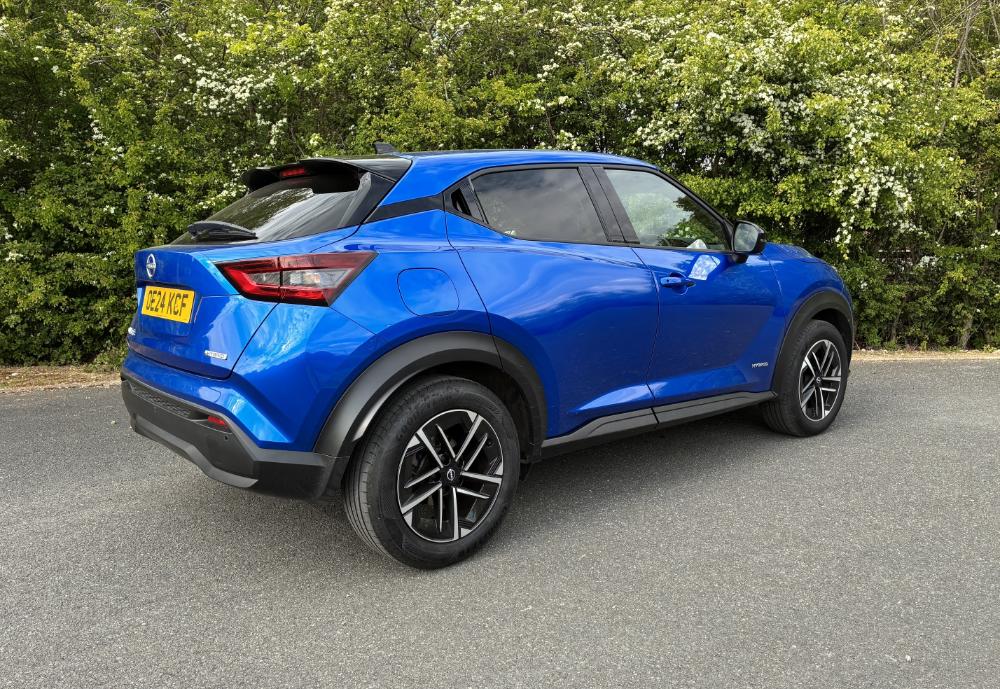
Having kickstarted the family SUV revolution with the Qashqai in the mid-2000s, Nissan turned its sights to the small SUV market with the first-generation Juke, which racked up sales as quickly as it did opinions on its divisive styling. Things became more restrained in design terms with the second-generation Juke, which was launched in 2019 and remains on sale to this day, with a facelift having been carried out in 2024. Clearly the changes were enough to keep the model relevant with buyers, with the Juke the UK’s fifth most-registered car in 2025. An all-new, fully electric Juke has now been announced, with its launch scheduled for 2027 – however, Nissan says sales of the existing hybrid Juke will continue alongside it.
Powertrain options with the current Juke are a 1.0-litre, 114PS petrol engine, or the aforementioned hybrid – as fitted to our test car – which combines a 1.6-litre petrol engine with an electric motor for a combined output of 143PS. The petrol engine comes with six-speed manual or seven-speed dual clutch automatic transmission, while the hybrid comes with an unusual electrified transmission, with four speeds for the petrol engine and two speeds for the electric motor.
The most obvious rival for the Juke in the small SUV segment is the UK’s best-selling car overall, the Ford Puma. We would also note the Renault Captur and Toyota Yaris Cross, since these join the Juke in being available with full hybrid powertrains.
Pricing and spec
The main Juke range consists of Acenta Premium, N-Connecta and Tekna+ trim levels, with prices starting at £24,485 for a petrol Acenta Premium, and rising as high as £32,395 for a hybrid Tekna+. In addition, a special Pulse Edition version was recently introduced that sits between the N-Connecta and Tekna+ trims, filling the gap left by the now-discontinued N-Sport and Tekna trims.
Entry-level Acenta Premium trim comes with features such as a 12.3-inch infotainment touchscreen, a 12.3-inch driver display, wireless Apple CarPlay and Android Auto connectivity, rear parking sensors and a reversing camera.
Next up is N-Connecta trim, with which standard equipment includes 19-inch alloy wheels, heated front seats, a heated steering wheel and front parking sensors. (We should note that Nissan recently changed standard equipment levels with the Juke range, and our previous-year N-Connecta test car had spec differences such as 17-inch alloys and a lack of heating for the seats and steering wheel).
Further features of Pulse Edition include a 360-degree camera system, a Bose audio system, interior ambient lighting and sat-nav.
Range-topping Tekna+ Jukes also come with features such as two-tone metallic paint, a heated windscreen, black leather and Alcantara seats and satin grey and silver exterior trim.
The entry-level petrol Acenta Premium Juke undercuts the cheapest versions of the Ford Puma and Toyota Yaris Cross – however, it is more expensive than the cheapest Renault Captur. This picture worsens with the hybrid N-Connecta spec Juke we tested, which remains more expensive than the equivalent Captur, and also becomes slightly pricier than the equivalent Yaris Cross.
Service intervals for the Juke are 12 months/18,000 miles, and there’s a three-year/60,000-mile manufacturer warranty.
Technology
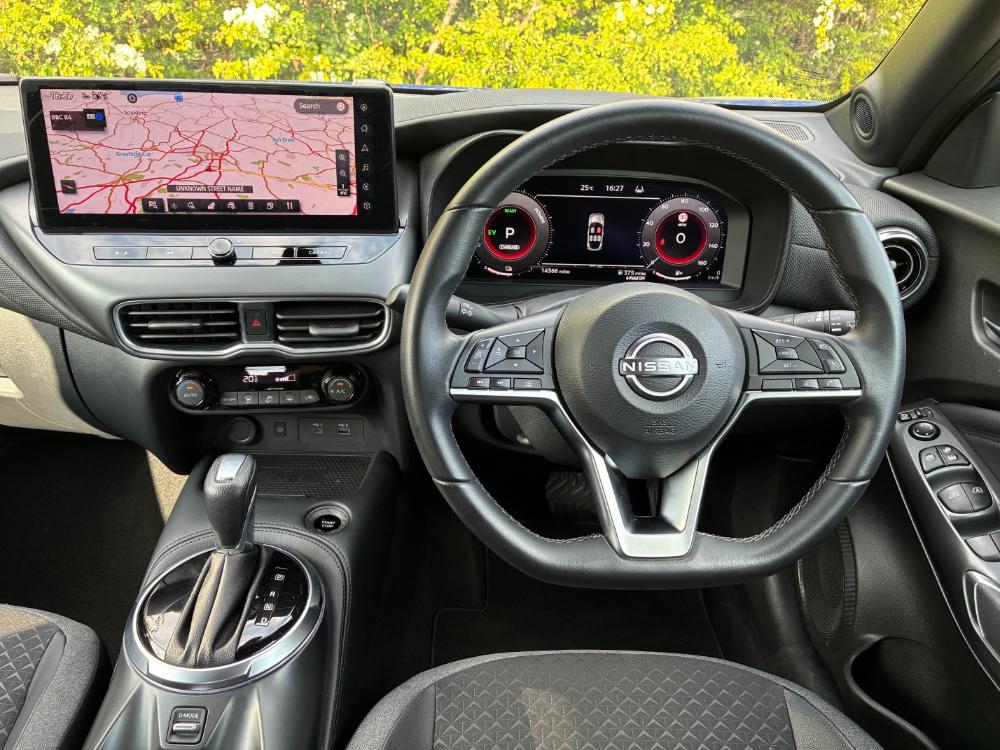
One of the headline changes with the 2024 facelift was the introduction of a larger, 12.3-inch infotainment screen throughout the range. This screen – which was also angled more towards the driver – is responsive and logically laid out, with clear shortcut icons down one side. Some settings are instead accessed via steering wheel controls and the driver display, which took us a bit longer to figure out but was straightforward enough to use in the end. This driver display was also enlarged to 12.3 inches in the facelift, and gained a wider range of customisation options – although we noted it is only able to display navigation instructions from the built-in sat-nav rather than from Apple CarPlay.
Safety
Standard safety systems with the Juke include autonomous emergency braking with pedestrian and cyclist recognition, lane departure warning and intervention and traffic sign recognition. From Pulse Edition trim up, an Advanced Safety Shield pack is standard, with features such as blind spot intervention, rear cross-traffic alert, lane keep assist and moving object detection.
Two presses on a steering wheel-mounted button switch off the overspeed warning and lane assist systems.
Select reverse gear when in full EV mode and the Juke emits a loud chirping noise – understandable as a safety feature, but it attracted some confused looks in car parks and we imagine it might make drivers unpopular with their neighbours if they regularly reverse park outside their houses late at night.
The Juke hasn’t been tested by Euro NCAP since way back in 2019 – it did at least receive a full five-star rating at that time.
Driving experience
The Juke Hybrid’s 143PS is enough to get it from 0-62mph in just over 10 seconds – adequate performance for the segment. We didn’t notice any unsmooth gearshifts or EV-to-engine transitions, however the engine sometimes produces an annoying droning note when cruising along at urban or B-road speeds, and is also quite loud under heavy acceleration. An e-pedal driving mode is selectable, but we would describe this as offering merely an increased level of regeneration, rather than the full one-pedal driving capability it brings with Nissan’s full EVs and the Qashqai e-Power.
We recorded 53.9mpg during our time with the Juke, which we think is creditable given this included plenty of motorway driving. An official WLTP economy figure of 58.9mpg is slightly worse than those offered by the equivalent Renault Captur and Toyota Yaris Cross.
The Juke offers a firm ride, with potholes and ruts in the road conspicuous from the cabin, meaning it is not the best choice for drivers prioritising comfort (we wonder if a lighter petrol Juke would be better here). The firmness doesn’t bring superb benefits for handling either – although the Juke corners reliably (and feels pretty solid when doing so, with weighty steering by modern standards) it doesn’t feel especially nimble. Overall, buyers looking for a more comfortable or dynamic drive should consider the Renault Captur and Ford Puma respectively.
The Juke’s big door mirrors are good for visibility, but noise from the wind rushing over them is quite noticeable at speed.
Practicality
For a lower mid-range trim we think the material quality with N-Connecta spec is up to par, with some higher quality plastics and leather mixed in with some scratchier, cheaper-feeling surfaces. There’s also a nice robust feeling to switchgear such as the indicator stalks. A nearly all black colour scheme isn’t the most interesting to look at, but things improve after dark when trim on the doors and around the gear lever is illuminated.
There’s not a great deal of storage space around the centre console, but you do get a large glovebox.
The front seats have sporty side bolsters, which we approve of, and we found it easy to achieve a comfortable driving position – although it would be better still with the option for more lumbar support.
Rear legroom is good for the segment, with plenty of space for passengers’ feet under the front seats, and headroom should be fine for all but the tallest. Reat seat passengers also have access to USB-A and USB-C sockets.
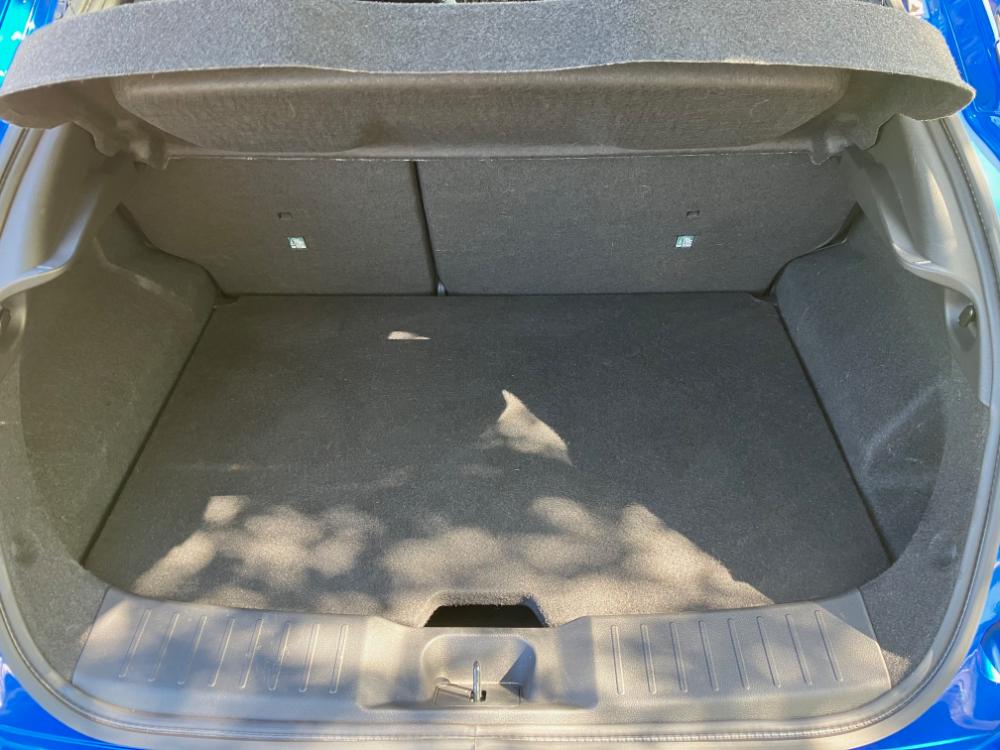
Hybrid Jukes have a boot capacity of 350-354 litres depending on spec – smaller than the 422 litres offered by petrol Jukes and relatively low for the segment. An adjustable boot floor means flat loading can be traded for extra space. When the floor is in its higher position, a near-flat extended load bay can be created with the rear seats folded.